Friday, 9 July 2010
Technique
Long, long ago in the tournament - when England were still in, that long ago - Giovanni and I had a little disagreement about "technique". I was arguing that the problem with the England team is not technique - that the issues are "psychological" in some sense. Partly my evidence for this would be that England players seem perfectly capable of trapping and passing a ball when they play for their clubs, but these basic competences desert them when they play for the national team. (As we saw most spectacularly with Rooney in this World Cup.) But, to ask an apparently naive question, is technique as straightforward a concept as it appears to be? After all, conceived of as a purely physical act (is that what technique means?), then passing isn't that difficult. Surely any international footballer has the "skill" necessary to play short passes to team-mates (and my impression is that there hasn't been much long passing in this tournament - Gerrard apart, but you can hardly class his wild punts as "passes" really). Don't misunderstand me. I'm not seeing keeping possession is easy - one thing I can unequivocally agree with Zone about is that the way Spain play is intensely difficult and demanding. What I'm saying is that the difficulties are more to do with the speed of thought, anticipation and awareness of team-mates' and opponents' positioning that a passing game entails - which is why Zone rightly invokes precognition when writing about Spain's passing. Is this still technique or is it something else?


Thank God for Jonathan Wilson
Jonathan Wilson's tactical survey of the World Cup focusses on Spain, while also reassuring me over my own sanity:
Although incredibly, Wilson's famously encyclopaedic brain has forgotten that putting a centreback upfront almost saw Barcelona through to the European Cup final this year:There are those who protest at [Spain's] lack of goals (no side has reached the final scoring fewer) but they are a classic example of a team that prefers to control the game than to become obsessed by creating chances. Perhaps they at times become mesmerised by their passing, perhaps there is even something attritional about it, wearing opponents down until they make the mistake, but it is beautiful attrition. Those who have protested at the modern Holland, and their supposed betrayal of the heritage of Total Football, which is being painted as the ne plus ultra of attacking football, should perhaps look back at the European Cup finals of 1971-73 when Ajax expressed their mastery by holding the ball for long periods. Frankly, if they ever faced a side who took them on rather than sitting eight men behind the ball, we may see a more overtly attacking Spain.
Which brings us to Germany. They too play a 4-2-3-1 and, although Philipp Lahm breaks forward occasionally, theirs is essentially a defensive set-up. Here again goals are the great betrayers; it was bewildering how much praise was heaped on their supposedly fresh, open approach just because they scored four goals in three games. This Germany was superb on the counter-attack, and the interaction of the front four of Miroslav Klose, Thomas Müller, Lukas Podolski and Mesut Ozil was at times breathtaking. But this was reactive football.
In three games, Germany scored an early first goal – against Argentina and England, it was essentially handed to them – and in those games they ruthlessly took advantage of the space opponents left behind them as they chased an equaliser. England, Argentina and Australia all defended idiotically against them, and were severely punished. In the other three games, teams defended decently against them and the early goal didn't arrive surrounded by watercress on a silver salver. In those games Germany managed one goal, and that a wonder-strike from Ozil. Against Spain their poverty of ideas was such they ended up sending the lumbering centre-back Per Mertesacker forward as an auxiliary striker, an idea so bereft of subtlety that the only time I remember it working was when Dennis Smith once sent Gary Bennett forward for Sunderland against Oxford in 1990.
Thursday, 8 July 2010
Myths Of The Near Past
I’m loathe to mention him here, particularly in a vaguely positive light, but Nick Hornby once said something interesting about football. It was in Fever Pitch, if I remember rightly, and it was to do with the way that supporters tend to use players as a mirror of their own values. So, a certain kind of middle class, thinking man’s fan will praise players for their intelligence and their artistry, particularly ones with a “cultured left foot”.
This language is highly revealing, more a checklist of cultural aspiration than an observation of footballing aptitude. It’s the reason that Arsene Wenger remains the darling of Arsenal, even if they don’t win anything. At least they lose in the right way. Similarly, tabloid sports pages typically praise workrate, commitment, bravery and strength in players and have no time for left feet, cultured or otherwise.
In English domestic football, there is clearly a class basis to these differences. Oddly, this only becomes more accentuated in international competition where a whole ragbag of other prejudices are brought into play including post-colonial guilt, cultural genuflection and recent geo-politics.
Of course, tedious national stereotypes count for a lot. It is impossible, for instance, for Brazil to play a game without the camera trawling the stands for beautiful ladeez while Clive Tyldesley makes endless references to Samba football. The interesting thing – and I’m far from alone in pointing this out here – is that Brazil could turn up and kick seven shades of shit out of the opposition whilst eaking out a nil-nil draw and they would still come away with their reputation intact.
National football reputations tend to be forged in some primordial sludge, out of which teams emerge fully formed, ready to fill out their pre-determined destiny. Nothing that actually happens to them during the course of the tournament will disrupt assumptions about the essential quality and character of their football.
Take Holland, for example, the perennial darlings of the more aesthetically inclined football fan. Every World Cup the same epithets are wheeled out. They are the aristocrats of Europe, solitary exponents of Total Football and, officially, the Best Team Never To Win A World Cup. Well, all that was true in 1974 (and ’78 although they were already by then without the talismanic Johan Cruyff) but since then they have, by and large, done little to justify the hype.
There is, as Zone Styx has pointed out, a sort of cognitive dissonance at work when people watch football. Regardless of what is actually happening on the pitch, they use the game to reinforce basic prejudices. A poor performance will merely elicit a series of questions as to why the team, say Holland, have not fulfilled their potential, or suggestions that they will really turn it on in the next game.
Like most forms of irrational belief, footballing prejudice is a self-fulfilling prophecy. All events reinforce the basic underlying assumption, however illogical. For some people, there are no German flair players, simply because they refuse to recognise them when they appear. As the current generation’s players are written off as workmanlike and predictable, so the myth is perpetuated. This is how Germany play, and this is how they will always play. Bastian Schweinsteiger, as sophisticated and subtle a player as you're ever likely to watch, was always battling against such popular misconceptions.
Spain have a similar but opposite affect, evoking weak-kneed wonder at their every move, even if it doesn’t get them anywhere or is boring to watch. They are poised forever before a moment of magic. Spain are a form of endlessly deferred wish-fulfillment, carriers of the flame for fans of sophisticated European culture (and a great nightlife) everywhere.
The fact that they have won most of their games one nil (with the goal, as Mark has pointed out, usually scored in the last 15 minutes of play after the opposition has become exhausted) never seems to puncture the myth. Last night’s match was a case in point, a game where Germany looked increasingly shagged out, not so much outplayed as outlasted. OK, so that’s unfair. Spain won because they kept possession superbly and (eventually) scored. But the goal, when it came, was not a thing of beauty, more the exception to their style of play rather than the rule.
Having said all that, a Holland versus Spain final is still a pretty fine outcome. A guaranteed new name on the cup is intrinsically a good thing. It could also put paid to some of the more irritatingly clichés of the international game. If Holland win, they will no longer be The Best Team Never To Win The World Cup. And, whatever happens, Spain can no longer be described as the perennial under-achievers of Europe. Two myths can be buried in one afternoon. Result.
Ghana's Double-Bind

Haven't been able to comment on the various ghost posts below because I can't figure out how to do it on my phone but here's a few thoughts:
Undeniably Brazil and the Netherlands are haunted by those (losing) teams of the past: 82, 74, 78. It's a burden that forced terrible changes to their formations and attitudes and now makes me sort of hate watching them. Spain are one of the only teams in the World Cup that don't seem haunted (and that's annoying too, isn't it?); they've kept on with their previously losing strategies and absolutely not caved in to the Hoodoo.
And then there's Ghana. Ghana seemed haunted by a combination of the beautifully erratic and brilliantly watchable African failures of the past, the kind that made Pele say what he said, the kind that we all wanted to see come good. Nigeria circa Jay Jay Okocha, Cameroon, even the much patronised Zaire, forever abbreviated to that guy kicking away the ball at the free kick.
The commentators were obsessed with Ghana's organisation and patience, as if such a thing from an African side was almost impossible to imagine. I vaguely remember a comment on TV saying something like: "It must be their European coaches..." Hardly racism but indicative of a creeping nostalgia for the old Africans, the ones you might find in old Geography textbooks, the ones with no size constancy scaling, who weren't tricked by the Muller Lyer Illusion, the ones who didn't play like we play, who had real freedom...
I guess this effect has been amplified by South Africa itself. The country and the team. It's a burden I think many of the African teams felt. To be African and not be African. A terrible double-bind. Laing and Girard and Bateson would be proud.
Hakim Bey: We've learned to distrust the verb to be, the word is...
Brazil certainly want/don't want to be Samba. England want/don't want to be Plucky Losers. The Dutch want/don't want to play Total Football. Ghana want/don't want to be Africa's Only Representatives in a relentlessly organised, eurocentric world.
What If Muller Was Suspended?

Only just watched the Spain/Germany Quarter Final, the highlights anyway. Must have been a difficult match to edit. Ought to be some kind of exemplar.
I heard bits of it on the night as I was eating in a hotel restaurant with all my colleagues; saw odd glimpses here and there on iPhones and, as it got darker, the occasional reflection in the windows. These parts signified the whole I thought; hypnotic (maybe boring), a very untense intensity.
I think someone on Twitter evoked Satriani as the guitar equivalent of Spain's technical, virtuous/virtuoso style of football and this reminded me of discussing Hendrix years ago when a friend turned off Electric Ladyland and said: "I can't listen to this. All the notes are in the right place. No flaws; it's not music anymore." And as we talked about this, it turned out that both of us liked only the bits of Hendrix that sounded a bit wrong, a little duff and that, in fact, this wasn't our unique indie-boy spin on Hendrix but these were the bits that most people liked.
Xavi, Iniesta et al are unlovable because of their virtuosity, that kind of thing is often annoying unless you happen to like Clapton. It's why the Sex Pistols sacked Glen Matlock and brought in Sid Vicious. It's why Usain Bolt has to try hard to develop a couldn't care less appearance. It's why we liked it that Socrates of Brazil and Johan Cruyff (even Gazza) smoked fifty thousand cigarettes a day.
It might be why we hate some of our colleagues. Why people find Martin Amis difficult. Why we need Mozart and Beethoven to be a bit mental. Why Jonathan Meades gets up people's noses with all his technically proficient, brilliantly conceived artistic smut.
Spain's game is unlovable because it's not a risky game to play but it's a difficult game to play. And exhausting; the pace (of the ball) might be missing but they need a massive physical effort to force those tight triangles. The style of play makes it essential that their players are in the right places at the right times (and that others are in equally dangerous but unused positions). I'd be interested to know what the distance travelled stats for Spain are: I'd imagine most of them cover a lot of ground before the passes are made.
And therein lies the problem. If people knew they were running hard, us English would like them more I think. We like a plucky trier. We like people to look like they're putting the effort in; it's why bankers have to stay in the office 'til 8 even though they're not doing anything. The Spanish make it look easy and that's not fair.
I heard that Spain had scored via a Spanish colleague dancing a mini-flamenco while a German colleague rolled her eyes. Everyone went dead. There was a brief longeur as everyone stopped eating and expected the old spectre: "Yeah but you can't ever rule out the Germans."
But no one said anything. It was a weird moment. No one believed that Germany would draw level. We hadn't discussed this but we didn't need to: it didn't seem possible.
A bit later, I thought about this, trying to figure out why people were reacting to the German team in such a way. This was the Germans, after all. And then it hit me: no one believes that Germany will pull one back because no one really believes that this is Germany. This German team seemed altogether less methodical and efficient (despite those terms still being applied by plenty of the TV Commentary teams), playing faster and looser and with various associated flaws. England and Argentina weren't comprehensively outplayed by Germany; they were sucker punched and then awe-struck. The Germans looked vulnerable at the back and suffered a lack of quality, game-changing, substitutes. In this way, the Germans were like England and Argentina; very beatable, only potentially wondrous. What if a team does stop Ozil? What if Schweinsteiger can't control the game? What if Muller was suspended? Well, you see where I'm going with this.
The Germans are an interestingly, excitingly flawed team; the team we love to love. The plucky (skillful) triers. This German team is part of a reinvention of German football that began, I think, at the last World Cup, where a less skillful team of plucky triers did well in spite of (because of?) their lack of star talent. Maybe they've always been plucky triers and we've only just noticed. Some awful collective amnesia has only made us think they were ever this ruthless, mechanised Will to win because... well, you know, I shouldn't have to spell it out... because of the...
In other words, could the Samba ever not have come from Brazil?
Anyway, it's these imperfections that we love and hate, in equal measure. Germans kick and rush, Mr Beckenbauer. All the teams we like do, a little. The rush bit is essential to our positive feelings. If only we could look at Spain and see the rush... But we can't. We're following the ball. And it seems to be moving so slowly...
The tick tock of Spain's passing, the grinding boot of The Netherlands +5% style are coming at us, taking over... Mark is right when he said on Twitter that the final, "looks so boring on paper that it might turn out to be a good match..."
Delayed Twitter Coverage of Spain v. Germany - Now in Blogvision
So I didn’t get up this morning for the Spain v. Germany semifinal. A series of very late nights at work counselled against getting up even at the relatively late time of 6.30am, New Zealand time. I just couldn’t do it. And so I recorded the game, and had to watch it sitting at my computer so I could monitor my email and work.
(Yeah, I know: poor dear.)
I wrote already about the dissonance of the delayed coverage, the having to go off the grid because information is everywhere, it’s in the very air we breathe. But try to follow in that manner a game in which nothing happens. It turned out to be a saving grace that this time, half to wallow further in the dissonance, half in preparation of something I might write next week about the World Cup and remediation, I decided to record my impressions of the game on Twitter.
I was surprised to discover after the game was over that this redundant coverage had found an audience, including some of my colleagues here at Minus the Shooting. And so it’s not solely (but let’s face it: mostly) in the spirit of extreme self-indulgence that I reproduce it below.
(At one point of the proceedings, Mark wrote: “reading @gtiso's delayed tweeting on the #ger -#esp game reminds me of the famous quote about Waiting for Godot: nothing happens twice”. Make it three times then.)
Stand by for delayed livetweeting of the Germany v. Spain game
One of the children paired up with the Germans at the anthem towers over Trochowski.
2 min The commentator just revealed the score of the other semifinal. What happened to spoilers?
(The Netherlands won, by the way. Apparently.)
8 min Spain appear to want to do it by walking. Saving themselves for late night post game fun run?
10 min Like watching paint dry so far. Winner meets Pearl Lusta in the final.
15 min Spain brought the ball and they're not letting the German children play. That's bad sharing.
(Also, wait until Adidas hears about this.)
22 min "It's one for the purists here tonight". Translation: the game blows.
30 min Spain shows how you play against Germany. They're young, susceptible to being bored to death.
34 min Boy, they left Villa open with a lifestyle block's worth of space there, pass nowhere near him.
45 min "Gradually, the game began to be something rather more than a mosaic of ill will and sullen fouling." Somebody wrote this about Germany v. Italy of 1982
45 min Gradually, this game is doing no such thing. End of first half. If we had video technology, they'd ask them to replay it.
Spain had never been to a semifinal before. They decided to stick with tradition and not be in one this time either.
Tragic news: the guy who was supposed to put together the first half highlights killed himself. Our thoughts are with his family.
47 min The second half has started. Allegedly.
50 min Xabi Alonso takes a shot and is booked.
51 min "Capdevila always makes himself available". Yeah, not unlike his sister. This game is so boring it's making me sexist.
55 min Commentator guy claims Germany is succeeding in stifling Spain. I would have thought it's the opposite and that Germany came in as heavy favourites
Then again, what the hell do I know?
58 min Oh my God. An actual chance! Villa doesn't connect by a gnat's crotchet. Okay, on replay, maybe two.
63 min What the hell was Podolski doing marking Sergio Ramos? He was lucky not to concede a penalty there.
66 min And we're back to walking. The pace suits Puyol, who's having his portrait painted by a Renaissance master at the back.
69 min Podolski! That was close, the Spanish defence had got its coverage all wrong.
71 min I think I just spotted Samuel Beckett in the crowd.
73 min And just like that Puyol scores! The ball didn't hit his skull at all, just the hair.
75 min I'm going to bore myself just writing it, but Spain has played a game of supreme tactical intelligence so far.
80 min Del Bosque so confident he reckons he can do it with ten men. Torres comes on.
82 min Pedro heard me! He tried to walk it in rather than passing to the wide open Torres. Harsh.
84 min Pedro is taken off and, I must assume, whacked with a ruler by Del Bosque. That was a howler before.
89 min One minute to go. Time added on by my reckoning should be about 80 minutes.
90 min The ref signals just three because he has someplace else to be. I see no other explanation.
93 min Spain has done it! Germany made to look very average. Take a bow, Del Bosque. Take notes, Maradona and Capello. Superb possession football.
Don't get me wrong, still very boring, eh? Tapes of the game to be used as a natural alternative to induce anaesthesia before surgery. But.
Podolski still on the field looking like he's discussing with his mates what just happened. Quite an endearing scene. They'll be back.

Wednesday, 7 July 2010
It's just like watching Brazil
When I was a postgraduate student at Warwick, James Williams gave a paper on Spinoza and Henry Miller. I don't remember the main point of the paper, but an offhand remark Williams made has stuck with me ever since: Spinoza wouldn't like sport. Williams was referring to Spinoza's rejection of both hope and fear as irrational passions. Since, Williams reasoned, the enjoyment of sport depends upon hope and fear, then Spinoza would find little to commend sport. I actually think this is incorrect - a dispassionate enjoyment of sport is possible. Non-partisan spectators can and do enjoy the aesthetic features of a match when they watch it replayed, the outcome already known. However, if one solely pursues this aesthetic model, then some dimension of the sporting experience is lost, the very things, yes, that Spinoza wants to overcome: suffering, pain, jouissance.
What I'm leading up to is a response to Zone's pondering about why there's so little enthusiasm for Spain here. He has some of the answers himself - the "cognitive dissonance" of watching Spain limp and press their way through games while the media bill and coo over their "scintillating sublimity" (two words, astonishingly, used by Alan Hansen tonight - you see, the emperor is not only clothed, he is wearing the finest imaginable clothes!; the smugonaut connoisseurship (which I resent in part because these people of taste will feel no pain if/when Spain lose). Then there's the sense of inevitability that Ben has talked of - a sense of inevitablity that has grown the more that Spain have progressed through the tournament. Spain have been sold to us as the heirs of Brazil 1970, but they have more closely resembled Brazil 1994. It's as if they've learned in the space of the three and a half weeks of the tournament what it took Brazil twenty-four years to discover. Spain's identikit victories over Portugal, Paraguay and Germany - airless games, devoid of theatre and settled by late opportunistic goals - have recalled the implacable drabness of Liverpool's triumphs in the 80s. All of which is fine; Spain have been grimly effective, no mean feat for a team that has so often disappointed in the past, and, let's be clear: Spain's achievement in reaching the final is massive, especially when you remember that, since 1970, only six teams have managed to do this. What I object to is being required to sit up and revere their play. Raphael Honigstein imperiously declared on twitter that "if you find that boring, you don't understand football" - but the defensiveness tells its own story. For me, great football is about drama, and Spain's combination of well-drilled defenders, a packed midfield playing hyper-aestheticised keepball and late goals is a formula practically guaranteed to eliminate all drama from the game. Spain have been compared with Arsenal, but I actually think that's unfair on Arsenal - sure, Arsenal might be similarly reluctant to debase themselves by, like, actually scoring, but matches involving Arsenal are rarely boring, in part because they can lose. All of Spain's games in this World Cup have been dreary - except the Switzerland match, which was dramatic by virtue of the fact that, for once, the inevitable didn't happen. But it has happened ever since. The dreariness is not all Spain's fault - it's a consequence of their opponents trying to squeeze and press them. But a team as great, and as aesthetically fine, as Spain are supposed to be could surely have found a more enthralling or inventive way through.
Partisanship is the key. It isn't those who were "better educated" about football who found tonight's game engaging, it's those who wanted Spain to win. For them, Spain's passing was indeed sublime artistry. But for those of us who didn't want Spain to win, or who wanted something to happen, their possession game was tedious. Yes, it might be difficult to do, but so is olympic gymnastics. As with olympic gymnastics, I might admire it; just don't ask me to enjoy it.
linking play
While the links have been quietly accumulating in the sidebar, I'd like to mention one site in particular, whose unflashy name, Must Read Soccer, belies how interesting it is. Essentially a clearing house for anything written on football that catches its author's eye, even a cursory check throws up:
Andrew Guest's On the Invention of Tradition - referencing Terence Ranger and suggesting an alternative motivation for Sepp Blatter's defence of the vuvuzela (although it also suggested to me a possible counter-narrative in which the vuvuzela is a kind of sod-casting, a Deleuzian territorialization of the space of the stadium and the space of fandom).
Jonathan Wilson on Uruguay's garra
Tim Vickery on the emotional immaturity of Maradona and (less predictably) Dunga
...and the World Cup read through Moby Dick
Spain is dead, long live Spain
I've been surprised to find so little support for Spain among the rest of the Minus contributors and other friends.
Partly this comes down to them being, as Mark put it, one of the smugonauts' choices – one of those teams that a certain kind of post-Hornby football fan will rave about as part of a leverage system to put them above the drudgery of supporting England. And as with Messi, as with Cristiano Ronaldo, as with Kaka and the entire Brazil squad, Spain have ended up introducing a kind of cognitive dissonance into the experience of watching the tournament. Whatever the evidence before them to the contrary might be, commentators and pundits simply cannot conceive of departing from the logic which sees the World Cup as the culmination of the season, and the inevitable stage for the reiteration of Messi, Ronaldo and Brazil as incantations of the Footballing Sublime – they know their appointed roles as cheerleaders and hype-merchants too well. Like Messi and Kaka, Spain have never quite clicked. They've still not shaken off that defeat to Switzerland. Torres is a shadow of himself. It's also true that at times they occasionally betray a sense of entitlement: Xavi, say, seems a little too convinced of the aesthetic and thus *moral* superiority of Spain's football.
But why wouldn't they? Contrary to M. Toledo, the commenter here who wonders if nostalgia has got stuck, unable to move beyond the 70s, I think this Spain team will be remembered as a highpoint in football history to file alongside Brazil 70 and Holland 74. It may only be when they're retired that we fully appreciate again the practically precognitive short passing of this Spain midfield. Why precognitive? Because the spectator may be able to see the pass a player should make, but they lack the skill to execute it. Good players can see it and execute it. At their best, such is the speed of Spain's one-touch passing that they're creating and exploiting situations before the average viewer can even take them in.
And I say this regardless of the outcome tonight. Because if Spain win, and then beat Holland, they will have confirmed their greatness in terms of the historical record: reigning World and European champions. This would tear up some of the seemingly immutable narratives discussed by DigitalBen here. But even if they lose, their unshakeable commitment to constant short-passing will only come to be seen as quixotic failure, exactly like Holland 74, and there is surely a windmill/Cervantes connection in there which only proves its profound cosmic rightness.
Maybe after the last few years of press gushing and international dominance many would love to see Spain toppled, but I remember the years and years of unsuccessfully tipping Spain as dark horses (not to mention the Czech Republic). This was a team as morbidly resigned to failure as any England team. Before Euro 08 they had only Euro 64 (on home soil) in the trophy cabinet. Spain should be cherished by anyone with even a glimmer of hope that England can overcome its own footballing fatalism.
Tuesday, 6 July 2010
Hoodoo Death
When I've talked to people about the World Cup, they often object to is the idea that the repeating patterns in the tournament mean anything. So what, for instance, if there haven't been any new winners who weren't hosts since 1958? Yet even if this sequence is ended on Sunday - and after today's result there's now a two in three chance that it will be - it doesn't invalidate the remarkable consistency up until now, over thirteen tournaments and 52 years. (One pattern has definitely been ended this World Cup: for the first time there will be a European winner outside Europe.) Even now, in a comparatively anomalous World Cup - which, however, could still be won by Germany of course - the semi-finalists included two former winners and one two-time finalist. If Spain make the final, they will be the first new non-host finalist since Holland first made it in 1974.
We've talked here a great deal about the importance of "belief". But the kind of "belief" that must be involved is of an uncanny type; it isn't a question of individual psychology, nor even of collective psychology in any simple way - we're not dealing with something like crowd behaviour, after all, where spatial and temporal proximity can account for influence. No: what we have to account for are persistences over long periods of time, in conditions where the causal mechanisms are obscure.
Tabloid-vernacular discussion of football will often invoke "ghosts", "hoodoos" and "bogey teams". Now, commonsense might want to dismiss such phenomena as mere happenstance (it just so happens that, year in, year out, Team X loses to Team Y), yet - as is often the case with commonsense - such a dismissal risks being far more absurd than trying to explain how they have happened.
One dimension here must be self-fulfilling prophecy, which Ben has discussed most recently in terms of Brazil. In his crucial 1942 essay "Voodoo Death", Walter Cannon showed how self-fulfilling beliefs can literally kill. Cannon studied victims of shock and of voodoo sorcery, discovering that, in both cases, the victims were caused to panic themselves to death. One of the values of Cannon's work is that, far from being some vacuous New Age nonsense about the "power of the mind", it goes into precise detail about the physiology of belief, the way beliefs are instantiated in the autonomic nervous system. At the same time, these self-destructive states cannot be triggered unless the individual in question already has certain background beliefs - it is only someone who believes in the power of sorcery who will die when a sorcerer points a bone at them, for instance. But it's not possible not to "believe" in Brazil's success ; it's a matter of brute factual record. And this history of success is not some neutral record which can be consigned into the past once the match starts - it forms part of the "psychological" texture of the match itself.
If it's a final between Spain and Holland then there are ghosts on both sides. But Spain might feel that, having gone two rounds further than they've previously managed, they've already laid the ghosts of their past failings, and now all bets are off. Holland's spectres, meanwhile, can only be confronted in the final. Holland's grinding progress through the tournament recalls that of Brazil in 94. As Loki pointed out on twitter, that Brazil team was "haunted by ghosts of a brillliantly skillful, but ultimately failed past", the 82 side, just as this Dutch side is stalked by the spectres of 1974. Will the Dutch exorcise that ghost even if they win the tournament?(One thing that occurred to me tonight: is football nostalgia like music nostalgia, forever stalled in the 60s and 70s? Beyond their own team's fans, there doesn't seem to be much nostalgia for any of the World Cup winners of the 80s or 90s, and except, perhaps, for the France of 98, it's hard to imagine such nostalgia developing in the future.)
Relevant and Irrelevant Histories
An interesting thought as we approach the end of this World Cup: although Uruguay have won World Cups in the past, and Spain and the Netherlands have not, Uruguay winning this year would be a 'newer' thing - more of an Event.
Spain finally lifting the trophy is a narrative that already carries a sense of inevitability - it's a triumph that has already been written, and held back from general release for two years. Now that Brazil have no longer already won the tournament, there's a case for saying that Spain have already won it. The same narrative can be quickly adapted and refitted for the Dutch - 'the long wait is finally over'. There is no comparably comfortable frame in which to fit a Uruguayan victory.

Granted, Uruguay's glories were a long time ago. But when has that ever been relevant to the expectations placed on football teams? Brazilian players are still being feted for what their team did forty years ago; England are judged (and judge themselves) every four years by the standards of 1966; African teams are still labelled as naive and impetuous based on the performance of Zaire in 1970. German teams and Spanish teams are just about still viewed in the context of their past representatives as villainous mecha-men and talented bottlers respectively, although these two seem to be finally losing their grip this summer. In the group stages, the BBC wheeled out an excruciating montage showing clips of past German triumphs interspersed with footage of pistons and machinery - but even they have since realised that this German team represents something different. These three-time World Cup winners would be fresher faces on the podium than the Spanish or Dutch.
Putting aside the two unfolding exceptions above - and progress on these fronts will be immediately undone if either team reverts back to historical type for even one game - these images seem impervious to the passage of time, and are held to remain true no matter how much contradictory evidence amasses. The fact that Uruguay have underachieved since 1950 doesn't explain the strange discrepancy about them; they are the only World Cup winners whose achievements have been definitively consigned to the history books, and deemed not relevant to modern analysis. You can never write off the Germans because of their past wins - but I don't believe I've ever heard a pundit say 'Well, I'll tell you what... I think Uruguay might be dark horses to win back their title this year. End the sixty years of hurt.'
In this country, the cutoff point for the relevance of sporting historical precedent is 1966. To us, tournaments before that period are quaint, sepia-tinted, and faintly comical. Two reasons - firstly because the World Cup only became a serious matter after we validated the tournament by going out and winning it. Secondly, the images teams made for themselves in the sixties and seventies have endured because those were the formative years of the people who have run, broadcasted, and commented on football in this country, certainly since the late eighties. Their ideas have bled into the minds of the population through sheer unchallenged repetition (and, lately, nostalgic replaying of said repetition - twice removed from new thought). Uruguay themselves are represented by a construction of this period - as temperamental foulers and cynics - and this seems to have replaced their earlier status as heroic two-time champions, leaving no trace of the older idea behind.
The relevant half-life of historical events must vary between countries. Uruguayan players surely don't go to tournaments still feeling burdened by the achievements of their predecessors, but Brazilian football fans still believe in a Uruguay hoodoo that dates back to 1950. Speaking to a Bosnian friend recently, I tried to draw out his opinion of the Stojkovic-inspired Yugoslavia team of 1990, but he was far more keen on regaling me with his admiration for the overachieving all-Serbian team at the first World Cup in 1930...


...who, it turns out, have been the subject of a recent film.
I doubt that a hypothetical English team sent upriver in 1930 would be the subject of such strong, enduring identification.
Sunday, 4 July 2010
'Underdogs don't play'
I wrote this piece before Brazil crashed out of the World Cup in a generally similar manner to a bunch of staggering, indignant drunks being thrown out of a pub at closing time.
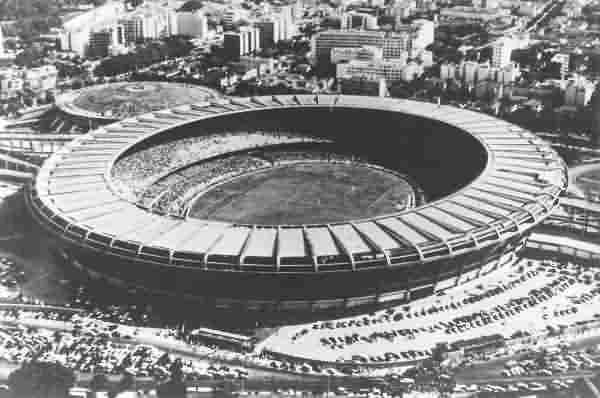
There wasn't exactly a World Cup Final in 1950, but the final pool game between Brazil and Uruguay effectively amounted to one. Uruguay only needed a draw - Brazil had to win the match to finish top. Waiting in the dressing room underneath the Maracanã, hearing the noise made by some 200,000 Brazil supporters, Uruguay manager Juan López Fontana called his team together and gave a speech along the lines of "Okay, lads, we're the underdogs here, we're playing away, so let's keep it tight and try to hold on for a draw." After Fontana had left, captain Obdulio Varela addressed his team-mates in a rather different tone: "Underdogs? Pfah. Underdogs don't play. Let's put on a show."

I've taken liberties with the wording and the whole story may be apocryphal - but as with all good stories, being fictitious wouldn't make it any less true. Varela was more right than he could have realised. The record of World Cups since that day in 1950 has shown that underdogs don't play - at least, not against Brazil. They seem to have the unique ability to intimidate smaller teams into all but eliminating themselves.
Brazil - great teams, average teams, desperately dull teams, it doesn't seem to matter - have finished top of their first round group in every World Cup since 1982. In six of those eight groups, they kept a perfect three-wins record. The only times they dropped points were in drawing with Sweden in 1994 and losing to Norway (thanks to a last minute penalty) in 1998. Even that isolated defeat didn't seem to break their stride: they still won the group and strolled past Chile in a routine second round game.
The list of teams who've actually knocked Brazil out of World Cups contains Hungary in 1954, Portugal in 1966, Italy in 1982, Holland and Argentina at various times, and France in two recent tournaments. There are no less illustrious names. For Brazil, there is no equivalent of Senegal-France, Croatia-Germany, USA-England. Or even Slovakia-Italy.
Looking past the calamitous defeats, the other major footballing nations have all struggled to beat theoretically weaker teams in difficult campaigns. Brazil seem uniquely able to cruise through World Cups without breaking sweat . A banana-skin exit at the hands of lesser opposition would be as unthinkable to them as failing to qualify.
What these statistics cannot convey is just how perfunctory the Brazilians' runouts against less illustrious opponents appear to the viewer. Mark has written about this before: it's almost as if, at some point after the playing of the national anthems, the opposition collectively realise that they cannot win, they're only playing for pride, and that the best they can hope for is an honourably narrow defeat with perhaps a consolation goal. The actual relative quality of the two teams becomes an irrelevance. The underdogs huff and puff, but believe that the game is over. And the mass hypnosis that affects the players seeps through to the broadcast team, who present the match in the same terms. "Chile almost deserve a goal, for their pluck," commented Clive Tyldeseley in the closing stages of Monday's game - at least he didn't call it "their World Cup final".
Recent victims of this self-fulfilling acceptance of defeat include Belgium (and arguably England) in 2002, Ghana in 2006, Chile in 1998 and 2010, the US on their own turf in 1994... many of these were talented teams, examined in isolation, and stood a decent chance in theory - but that was of no relevance once the Brazil-determinism of the knockout stages swung into effect.
Mark ended his Brazil post by asking who could possibly stop them this time round. Well - the one team who seem to unsettle Brazil, and who are able to turn the historical record against them, are Uruguay. They may not be among the tournament favourites, but it would be nicely fitting if they held on to their fortitude and turned the psychological pressure on the seleção.

With hindsight, I'd add that the bewildered way Brazil reacted to being behind and under pressure against the Dutch showed just how much even they rely on this 'self-fulfilling defeatism'. When the script doesn't go as expected, Brazil don't seem to have any additional sources of mental strength - they simply fold. For the amateur-hour defending and petulant tantrums in the second half against Holland, read the dazed performance by the whole team against France in 1998.
I agree with various contributors here that the power of belief in football is a subject that deserves to be explored in more depth.
There wasn't exactly a World Cup Final in 1950, but the final pool game between Brazil and Uruguay effectively amounted to one. Uruguay only needed a draw - Brazil had to win the match to finish top. Waiting in the dressing room underneath the Maracanã, hearing the noise made by some 200,000 Brazil supporters, Uruguay manager Juan López Fontana called his team together and gave a speech along the lines of "Okay, lads, we're the underdogs here, we're playing away, so let's keep it tight and try to hold on for a draw." After Fontana had left, captain Obdulio Varela addressed his team-mates in a rather different tone: "Underdogs? Pfah. Underdogs don't play. Let's put on a show."
I've taken liberties with the wording and the whole story may be apocryphal - but as with all good stories, being fictitious wouldn't make it any less true. Varela was more right than he could have realised. The record of World Cups since that day in 1950 has shown that underdogs don't play - at least, not against Brazil. They seem to have the unique ability to intimidate smaller teams into all but eliminating themselves.
Brazil - great teams, average teams, desperately dull teams, it doesn't seem to matter - have finished top of their first round group in every World Cup since 1982. In six of those eight groups, they kept a perfect three-wins record. The only times they dropped points were in drawing with Sweden in 1994 and losing to Norway (thanks to a last minute penalty) in 1998. Even that isolated defeat didn't seem to break their stride: they still won the group and strolled past Chile in a routine second round game.
The list of teams who've actually knocked Brazil out of World Cups contains Hungary in 1954, Portugal in 1966, Italy in 1982, Holland and Argentina at various times, and France in two recent tournaments. There are no less illustrious names. For Brazil, there is no equivalent of Senegal-France, Croatia-Germany, USA-England. Or even Slovakia-Italy.
Looking past the calamitous defeats, the other major footballing nations have all struggled to beat theoretically weaker teams in difficult campaigns. Brazil seem uniquely able to cruise through World Cups without breaking sweat . A banana-skin exit at the hands of lesser opposition would be as unthinkable to them as failing to qualify.
What these statistics cannot convey is just how perfunctory the Brazilians' runouts against less illustrious opponents appear to the viewer. Mark has written about this before: it's almost as if, at some point after the playing of the national anthems, the opposition collectively realise that they cannot win, they're only playing for pride, and that the best they can hope for is an honourably narrow defeat with perhaps a consolation goal. The actual relative quality of the two teams becomes an irrelevance. The underdogs huff and puff, but believe that the game is over. And the mass hypnosis that affects the players seeps through to the broadcast team, who present the match in the same terms. "Chile almost deserve a goal, for their pluck," commented Clive Tyldeseley in the closing stages of Monday's game - at least he didn't call it "their World Cup final".
Recent victims of this self-fulfilling acceptance of defeat include Belgium (and arguably England) in 2002, Ghana in 2006, Chile in 1998 and 2010, the US on their own turf in 1994... many of these were talented teams, examined in isolation, and stood a decent chance in theory - but that was of no relevance once the Brazil-determinism of the knockout stages swung into effect.
Mark ended his Brazil post by asking who could possibly stop them this time round. Well - the one team who seem to unsettle Brazil, and who are able to turn the historical record against them, are Uruguay. They may not be among the tournament favourites, but it would be nicely fitting if they held on to their fortitude and turned the psychological pressure on the seleção.

With hindsight, I'd add that the bewildered way Brazil reacted to being behind and under pressure against the Dutch showed just how much even they rely on this 'self-fulfilling defeatism'. When the script doesn't go as expected, Brazil don't seem to have any additional sources of mental strength - they simply fold. For the amateur-hour defending and petulant tantrums in the second half against Holland, read the dazed performance by the whole team against France in 1998.
I agree with various contributors here that the power of belief in football is a subject that deserves to be explored in more depth.
Saturday, 3 July 2010
The Good Soldier Suarez
"Luis Suarez - hero or villain?" - it's an obvious question to ask after last night's events in Johannesburg. But maybe we need to look beyond the "unadulterated fist-pumping joy" of Suarez, after he "saved" Uraguay's World Cup dreams against Ghana, to see another dimension of the piece, a dimension that comes most starkly into view when we (quite naturally) compare it to that other infamous handball. So, tongue ever so slightly in Zizekian cheek, I would like to suggest that, in comparison to Diego Maradona's 'perverse' Hand of God, Senor Suarez's intervention was a far more radical and destabilising act....

In contrast, the Suarez event is more radical, more real, more disturbing, for it all happened within - the gaze of - the law. The law was not transgressed, it was followed to the letter, and thereby its failure - its groundlessness and absurdity - was revealed, its ultimate impotence laid bare for all to see.** As an arbitrary and violent imposition of order onto contingency the law makes the game (all games) possible but we need to be reminded of its all too human origins, that it is not all-powerful (is 'non-all') and cannot legislate for all eventualities. This opens up the possibility of our taking some minimal distance from it, appreciating once more that we, and not the gods, are responsible for the law, and that, at the end of the day, while "you've gotta take each game as it comes", you mustn't let that blind you to the fact that it is a game and as such reliant on an ineliminable element of chance (not to mention violence - as many Ghana fans would no doubt testify today).
Ergo, the Good Soldier Suarez is a radical hero!
 * "Maradona lifted the World Cup trophy, ensuring that he would be remembered as one of the greatest names in football history. In a tribute to him, the Azteca Stadium authorities built a statue of him scoring the "goal of the century" and placed it at the entrance of the stadium" (http://en.wikipedia.org/wiki/
Maradona#1986_World_Cup ) - in granting the official Genius of his other goal, the "authorities" were clearly quite happy to turn a blind eye to his act of transgression....
** similar arguments could be made about the Lampard and Tevez "goals" last weekend perhaps....?

Maradona's gesture was, properly speaking, 'perverse' in that it was a direct - obscene - transgression of the rules which effectively re-inforced the status of the law: after the event "Maradona" could indeed be accorded a simple, binary, symbolic significance - as hero or villain, redeemer or cheat - whose actions merely proved the necessity of regulation. He got away with it (much like every pilled-up hedonist "gets away with it" every weekend) and there was considerable collective jouissance to be had as a result (especially given the Falklands and all that). And what was it that he and his hombres were really glorifying in if not the perverse pleasure of successful naughtiness, the 'obscene superego supplement'? His was an act of symbolic transgression; an attempt to prove that he was 'above' the law - thereby revealing his implicit reliance on the law as the constitutive ground for his own megalomaniacal ego - and one that the law, for its part, was quite happy to go along with, knowing its authority was in no real way being challenged.*
In contrast, the Suarez event is more radical, more real, more disturbing, for it all happened within - the gaze of - the law. The law was not transgressed, it was followed to the letter, and thereby its failure - its groundlessness and absurdity - was revealed, its ultimate impotence laid bare for all to see.** As an arbitrary and violent imposition of order onto contingency the law makes the game (all games) possible but we need to be reminded of its all too human origins, that it is not all-powerful (is 'non-all') and cannot legislate for all eventualities. This opens up the possibility of our taking some minimal distance from it, appreciating once more that we, and not the gods, are responsible for the law, and that, at the end of the day, while "you've gotta take each game as it comes", you mustn't let that blind you to the fact that it is a game and as such reliant on an ineliminable element of chance (not to mention violence - as many Ghana fans would no doubt testify today).
Ergo, the Good Soldier Suarez is a radical hero!
 * "Maradona lifted the World Cup trophy, ensuring that he would be remembered as one of the greatest names in football history. In a tribute to him, the Azteca Stadium authorities built a statue of him scoring the "goal of the century" and placed it at the entrance of the stadium" (http://en.wikipedia.org/wiki/
** similar arguments could be made about the Lampard and Tevez "goals" last weekend perhaps....?
The rearview mirror, the big Other, and the persistence of the past
When will Lionel Messi have had a mediocre tournament? One of the most irritating things about commentariat "common sense" is the way that judgements that are presented as universally accepted are silently reversed. All of Messi's touches have been greated with expectant rhapsodies of awe, even though he has never exploded into anything like the form of which is he is capable. And in the last couple of games, especially today, he has for large parts of the match been a flickering shadow; not as bad as Rooney, for sure, but certainly no better than Lampard against Germany, who did at least hit a shot across the line. Note: I am not, ludicrously, saying that Messi is overrated. But, with its usual bout of self-loathing sado-masochism, English media have been very quick to conclude that Rooney's desperately poor showing here means that he is overrated, often comparing him unflatteringly to Messi. Messi had the advantage of playing in a side that - until today - was winning easily; Rooney was playing in a team that was labouring. Note also: I am not saying either that Rooney is as good a player as Messi, only that Messi has been given the benefit of the doubt far more than Rooney was.
Partly, what I'm describing is due to what McLuhan called rearview mirror thinking. Commentators and pundits filter what they are seeing according to models rooted in the past, bending their perception to fit their expectations rather than adjusting their expectations in line with the facts. This syndrome used to be screamingly evident in the treatment of Brazil, and, twenty years after they converted to dour pragmatism augmented by occasional flair and predatory goalscoring, their reputation for playing Samba football remains astonishingly resilient - even if only the most selective of viewers could eulogise their organisation, backfiring backheels and packed defence this tournament.
Partly, it's a matter of what the big Other is held to acknowledge. With Brazil, the big Other was only supposed to notice their flicks and flamboyance. With Messi this tournament, the commentariat have been like courtiers trying to conceal shoddy workmanship from a monarch, as they sought desperately to keep Messi''s many patches of indifferent and ineffective play from the big Other's gaze. But the defeats of Brazil and Argentina over the last couple of days have been shock moments which have a retrospective impact, shattering the official narrative, and allowing what was always in fact the case to be recognised as such. When I suggested that "Brazil have already won the World Cup" I wasn't saying that they would win it, rather that if they did win, the victory would have been inevitable. Nothing would have happened. The officially constituted (and Nike sponsored) reality would have confirmed itself. But as soon as they hadn't already won it, they couldn't do enough to earn the win.
This brings us back to the role of belief and expectations. Germany started today's game with the evident conviction could beat Argentina, which already sapped the Argentines of much of their power. The same thing happened in the second half of the Netherlands-Brazil game, when Brazil's invincibility crumbled like Ceauşescu's tyranny; there was no gradual transition from inevitability of victory to defeat, just a sudden and total disintegration. But Ghana yesterday and Paraguay today palpably lacked that belief; like many of the less fancied teams, their strikers came up against what was in effect an invisible forcefield when they closed in on the opponents' goal, shooting wildly over the bar or uselessly into the keeper's body. It's no accident that both Paraguay and Ghana went out because they failed to convert penalties. In the penalty shoot-out against Japan, the Paraguay players looked like they could have scored penalties all night - but today Cardoso, like Gyan last night, seemed so paralysed by nerves that it was impossible to imagine him scoring. They had come up against the belief barrier.
Argentina's defeat today was comprehensive by any standards. They probed lislessly without really pressing, and, besides the clearly and indisputably offside goal, they created far fewer clear goalscoring opportunities against Germany than England did. Must we now conclude that there is a "gulf in class" between Argentina and Germany? The one thing that this World Cup has definitively proven is that this "gulf in class" does not exist; there are not South American and Spanish Deities on another technical plane to other teams. What Germany had over England and Argentina was not a technical advantage, but a manifest superiority in pace and discipline. As Zone argued, Germany's destruction of England was a consequence of Germany literally beating England at their own game - and that "English-style" football requires a pace and energy that was physically and mentally far beyond the England players, who, in a horrible vicious circle, tried to compensate for indiscipline and disorganisation with the very bluster that produced the organisational collapse in the first place. Argentina, meanwhile, found it impossible to run the game at their tempo, and, like Brazil, they were unable to adjust to being behind in a game. Spain have survived this far in the competition not because of their vaunted passing game, which has sparked only sporadically in the last couple of games, but because of their tenacity and Villa's opportunism. I'm not sneering at these things - they are exactly the qualities Spain needed to develop in order to face down the very daunting ghosts of their past under-achievement. Ominously for Germany - who by any metric are far and away the most exciting team this tournament - Spain are now playing badly enough to win the World Cup. However, Spain still have massive hauntological obstacles to overcome - not least the fact that Germany have never gone more than twenty years between World Cup wins since they first won in 1954. As I've already pointed out, Spain would be the first new winner of the World Cup who wasn't the host since 1958; they would be the first reigning European Champions to win the competition since West Germany's victory on home soil in 1974 (which was in fact the only occasion so far on which the winners of the European championships have gone on to win the World Cup); and they would be the only team ever to lose their first game and end up winning the tournament (this last fact makes them more closely resemble Argentina in 1990 - who lost to Cameroon in their opening game - and West Germany in 1982, who lost to Algeria in their first game: what do these teams have in common? They ended up losing in the final. Remember also that Holland in 1978 might not have lost their opening game, but they did suffer a shock defeat in the first round - to Scotland - and they too ended up losing in the final.) Spain would also be the first European team to win outside Europe. The Netherlands run up against many of the same precedents, these eerily repeating patterns. As for Uruguay - well, even though they seem to be the underdog of the four remaining teams, they are not similarly ill-starred. And, unlike Spain and Holland, they have won the World Cup before, twice in fact.
Friday, 2 July 2010
The Art Of The Non Spectator

An Imaginary Art Installation
The World Cup final. At the whistle, the crowd fall silent. Sit for ten minutes in complete silence, each feigning a different form of shock and awe. Then, row by row, still in silence, everyone files out the ground. By half time, the stadium is empty. The players have to come back out for the second half to an empty stadium. 5 mins into the second half, all the spectators run back into the stadium mouthing wordless obscenities and doing an odd dance like they've developed a 24hr strain of autism. Sit down and watch in silence for the rest of the game.
The Goalkeeper's Fear Of The Penalty

As the World Cup circles get tighter and tighter then the question of penalties raises its head. Quarter Finals now and who would bet against them occurring somewhere...
Now that England are out and the autosuggested fear of missing becomes less of an issue (though of course the Dutch are still in the competition), attention has switched to the fears of the goalkeeper, who is often assumed to be the only one in a penalty shootout with nothing to lose.
Not so, or so this article suggests.
Ofer Azar, a Behavioural Economist, argues that the goalkeepers have a very real fear during a penalty which can be roughly (perhaps wrongly) translated as the fear of being seen to do nothing. Although it's statistically better for them to stay in the middle of the goal, they tend to feel the need to dive spectacularly one way or another even if they know this is a strategy doomed to failure.
This is a kind of inverse Omission Bias (the tendency to judge harmful actions as worse than equally harmful omissions or inactions) which could be argued as an emotional flaw in logic which dogged England, France et al at this World Cup - the fear of being seen as inactive (i.e. uncaring, lacking in passion) led to players overdoing things (think of all those long raking aimless balls from Gerrard, the bizarre crossfield dribbling of Ribery).
The Game Never Ends
I've enjoyed the last couple of game-less days. The plan to watch all of the fixtures was a fine one in principle, but it had begun to seem a bit of a chore to be honest. Not that I'm complaining about the level of play: I think it's been a good tournament so far. At the time of writing the two most exciting attacking teams - Spain and Argentina - are still in it, whilst Germany, Brazil and the Netherlands are playing with less obvious flair but still quite entertainingly. It's great to have Ghana in there and the two Guays are adding a bit of dark horse vivacity to the whole thing. So I won't complain. Still, there's only so much football you can take before a certain element of drudgery creeps in, to coincide with what is pointedly referred to as the 'business end' of the competition. None of the teams that are left in the tournament are in it to entertain at this point, if they ever did. Not even Argentina. They're all in it for the bottom line, and that is to win or, in the case of the lower-ranked three, to make a historic semifinal at least.
Success and failure. One of the side stories of South Africa 2010 has been the early exit of most of the Nike stars, the chaps who were supposed to write the future. I actually didn't think that the campaign was has bad as it has been made out to be. There was more than a little cheek in Ronaldo's dream of a colossal bronze statue to match the size of his ego and the sculpted iconicity of his Mussolinesque pout, and you wouldn't put it past that character to spit at a cameraman on his way out of the tournament if things didn't go to plan. It was always going to be either the triumph of the will or the fall of the ungracious.

The ad starring Cannavaro was genuinely funny, chiefly thanks to the brilliantly cast Bobby Solo, but I was intrigued by the extended version of Rooney's story, the only one to write in the prospect of failure. In this one the two alternative finales - with Roo either ending up living in a trailer park or bear-hugging the Queen and having all male boys of the realm named after him - was refreshingly open to the possibility that the future would be written by the non-Nike-wearing anonymous player mob. I felt that you could do something with that, that it wasn't as tightly controlled and depressingly closed a text as most sports ads are at this level.
I'd also caution against sneering at the Nike campaign because they might get the last laugh yet -
But by far the more emblematic tagline of the tournament to my mind belongs to this commercial.


There it is, the drudgery, in a formulation that is a concise as it is soul-crushing: The Game Never Ends. And: Keep Playing. Moreover, it applies not only to professional footballers, but to the rest of us as well, who are left with no choice but to embrace that philosophy of sacrifice, that commitment to the ultimate effort, even in our streets, in our parks, on our beaches. No more of that old “that’s it for me, I think I’ll be heading home” business. The game never ends.
In panning cleverly from one country and one culture to the next, the Powerade commercial paints a vivid picture of global joylessness. It is not so much the other side of top sporting events as it is integral, central to it; it is the very serious business of winning, which is the thing that sport has in common not just with the military but also with corporations. Obvious as it is to remark, that’s why you’ll find motivational management strategies used in sports teams, and ‘team-building’ exercises and a whole host of sports metaphors, gestures and tics featuring prominently in the workplace. And for capitalism to reach maximum efficiency, it is necessary that leisure and work be as indistinguishable as the transition between the two is seamless. Work is play, and play is work.
I wrote that Argentina is as much in it to win it as the others, but I must also note Maradona’s very careful strategy to project the image of a team that is capable of having fun. It’s as if he has chosen to be the anti-Dunga, and for Argentina to be the antagonist of the reality principle that is Brazil, encouraging us to read this new and in some respects surprising chapter of the great South American rivalry as a struggle for the very soul of football. That’s the narrative that the shrewd Maradona is offering to us, at any rate. And it is a fiction, to be sure, but a useful one, if only to combat the feeling that what we’re about to do in the next ten days or so - when the game will end - is not to so much to enjoy a series of games as to conduct a review: without enjoyment, without passion, writing a future that is pre-determined by the objective and measurable superiority of the winning team.
You can watch the Powerade commercial in its full, exhausting four-minute length here.
Peter Lorre On Legs

England should immediately disband all Under 21 matches. This team should be the full England team, with maybe a few old heads, willing to stay in the side as the Gary McAllister figure(s). Maybe these 'old' guys might even have a few final hurrahs like McAllister did for Liverpool - Houllier described him as his "most inspirational signing" and you can hardly disagree.
Which old heads? You'd have to ask them; "Hands up, who wants to be the fading star? It really is a better role than you seem to think..."
Or: "Who wants to be the Schweinsteiger?" - they don't have to be literally old.
Next, we should ditch all expectations for at least 2 years. Don't worry about winning. Winning doesn't really seem to help (reference our World Cup qualifying campaign). Forget winning. Winning is overrated.
Insert Karl Popper here.
In retrospect the verification bias after the Croatia matches sent us spinning; sent Capello into an odd mysticism, gave him more self-belief than was required. He knew this at some deep unconscious level, tried admirably to deal with it himself by ditching Walcott at the last minute.
It was just Croatia. It was just Croatia...
Capello saw this coming. He's a good manager. He saw this. But the expectation of England is differently intense to the expectation of Italy or Madrid or whoever. It's expectation tinged with no expectation. We're the best apart from the best.
We're still worrying about never being Brazil even when Brazil don't care about being Brazil.
So...
Let the young uns get thumped a little by the older, more experienced sides (I'm not convinced that experience is that much of a factor anyway at International Level because there's just not enough planning time to get the team together). Let us even fail to qualify for the Euros. Let's instead work on figuring out a way to play before the next World Cup.
Let them find their way around the pitch a little. See who emerges. See where they emerge. Let them make some mistakes (could they make more than the seniors?).
I know our U-21s got fairly roundly beaten by the, er, Germans in the 2009 U-21s final but, hey, who was man of the match?
Yep. Ozil. Petter Lorre on legs.
I think there's something to be learned.
Thursday, 1 July 2010
tipping point in America
I'm fairly certain that, despite the USA's missed opportunity against Ghana, the 2010 World Cup was *finally* the tipping point for soccer in America. It's a major sport for us now.
No further evidence is needed than today's column at ESPN by Bill Simmons, probably America's liveliest sportswriter in recent years (and also a Tottenham Hotspur fanatic, which is no longer an Anglophiliac affectation in the USA of 2010 as it might have been even 5 years ago). As his remarks indicate, part of the problem is that we are simply sick and tired of American sports. I certainly am, and it was my primary personal recreation from about 1975-2000 before moving to Egypt.I agree with every word of the following, for instance:
"I love the Cup because it stripped away all the things about professional sports that I've come to despise. No sideline reporters. No JumboTron. No TV timeouts. No onslaught of replays after every half-decent play. No gimmicky team names like the 'Heat' or the 'Thunder.' (You know what the announcers call Germany? The Germans. I love this.) No announcers breathlessly overhyping everything or saying crazy things to get noticed. We don't have to watch 82 mostly half-assed games to get to the playoffs. We don't have 10 graphics on the screen at all times. We don't have to sit there for four hours waiting for a winner because pitchers are taking 25 seconds to deliver a baseball."
Anyway, here's the link to the whole article:
http://sports.espn.go.com/espn/page2/story?page=simmons/100701
The Compulsion to Repeat
Danny Baker has talked about English fans and experts being "too quick to call an autopsy without a body". It's hard to disagree. But while our patient isn't dead, he is starting to exhibit some very strange symptoms...
The betting market for the next England manager is throwing out some uncannily familiar names. Almost every single one of our past managers is quoted. This isn't new - every time we look for a new manager, we seem to be consumed with nostalgia for one or more previous incumbents. So go on, take a punt on Kevin Keegan at the numerically significant price of 66-1. How about Terry Venables, who's been in the running every time since 1996? Or even... Steve McClaren, who's as short as 20-1 at one place? He seems to be going through levels of hurried reappraisal as quickly as the newspapers can put out new editions.

Why would there be any kind of call for McClaren to retake the job, only two years after he was laughed out of it? It would nice to think that this phenomenon was due to a sincere reappraisal of his worth following his success in the Eredivisie. But the press, who had fun at his expense for so long (how they crowed at his adopted Dutch accent), have never been ones to revise their opinions so quickly. When Twente took their first steps toward the title, it was reported (generally in thumbnail-sized articles in the inside pages) with a kind of detached amazement/amusement, with the implication that the progress said more about the Dutch league than about the manager's skill. The serious reconsideration of McClaren is a phenomenon that only dates back to the trauma of the last week.
The logic being used to build the man up by the same people who relished knocking him down is tortuous. The pundits are spinning a narrative of how quickly he has learned the ropes, and how the England job came 'just a couple of years too soon for him' - but managers don't go from imbecilic to ingenious in the space of twenty-four months. The fact that McClaren and even Kevin Keegan are now considered as serious - albeit outside - candidates to return to the England job calls for some kind of deeper explanation. This isn't just rose-tinted nostalgia - this is the desire for repetition.
We can turn to Freud, who identified one of our most powerful and overriding desires - the compulsion to repeat. We unconsciously re-enact earlier events in an impossible attempt to be able to go back and change them - and we feel compelled to do this even when the experience will be painful and cannot possibly affect the original, traumatic event. Repetition does not even help us deal with the trauma - it simply extends it. Freud could find no self-interested explanation for this behaviour, and reluctantly classed it as one of the few motivations that could override the otherwise dominant pleasure principle. We repeat even we know it will cause us pain.
We want McClaren back in charge because, hey, he's turned out not to be a laughable mug after all, and we aren't sure how a man like that failed with our Golden Generation. We want Terry Venables back in charge because we aren't entirely sure how we failed to win Euro '96, when things seemed to be going so well - surely, if we repeated it all, everything would come good? We want Glenn Hoddle back in charge because we aren't sure when, or how, he lost his good relationship with the players (close to them in age, respected by them for his enduring ability on the training pitch) and became an unpopular laughing stock in the dressing room. Surely it should have ended better? Surely it would end better a second time?
But acting out traumatic events in this way precludes remembering them. The more we become caught up in repetition, the further we get from being able to analyse and learn from the events of the past. English football isn't a corpse on the autopsy table, but it might help to think of it as a patient on a psychiatrist's couch - and re-enacting the past isn't going to help him get over his problems.
 "Maybe... just maybe."
Subscribe to:
Posts (Atom)