"Frank Lampard, we can all agree," wrote the Wing Commander of last night's debacle, "has rarely put in a finer performance than the one he put in tonight. He occupied the centre circle like some international spy passing anonymously and unnoticed among the hordes of the foreign foe, unnoticed, indeed, by anyone at all." Lampard has the curious ability to be so invisible for England that you genuinely forget that's he's playing; it'll sometimes be the 70th minute or so before I remember that he's in the team. You can't make the same mistake with Gerrard (whose play last night, according to the Wing Commander, "was almost telepathic – it was if he was passing to colleagues who existed only his own head"). Gerrard is a high visibility player, regularly involved, not always successfully (in fact, it's hard to think of another player of such high quality who gives the ball away so frequently and so cheaply). But it's hard to imagine any other player performing so consistently indifferently for England as Lampard has and still keeping their place, and after last night you wonder if England would do better if the "spine" that was supposedly so crucial to their success was ripped out. Carrick can be a diffident sort of player, but could he be as anonymous as Lampard has been? Dawson is inexperienced, but it's unlikely that he would be as laborious and lethargic as Terry, surely the most overrated of England's "stars". And Defoe and Crouch looked as if they might pose some goal threat, unlike Rooney and Heskey.
By the way, just in case there are those who aren't aware: the Wing Commander's Send Them Victorious, justly described by Brian Phillips of Dirty Tackle as "the funniest World Cup of all time", is out now on Zer0.
Rooney's misfiring. Lampard and Gerrard are woeful. The defence is leaden and unconvincing. It's not that dissimilar to 2006.
There's one thing that we did have in 2006 though. This man:
Public opinion of players often swings in their favour more when they're not playing than when they are- we've seen it this week with Gareth Barry and Joe Cole. And we saw it with Beckham in '98. But he's a forgotten footballer now (though very much not a forgotten man: we had five close-ups of him looking pensive on the bench last night)- his injury was so long ago that we can't imagine him playing in this World Cup.
But he could've made a difference last night. That game against Paraguay (who- at least according to Fifa- are of similar quality to Algeria) was terrible, but a good Beckham delivery forced an own goal. Then we were dire against Trinidad and Tobago, but a Beckham cross provided Crouch with an assist (as did some dreadlocks). And then a similarly flat performance against Ecuador sufficed because Becks knocked in a free kick. He didn't do a lot else, and there was a fair bit of clamor for Lennon (who was impressing in substitute appearances) to make a start- but it was felt he wasn't quite there yet, because his crossing needed a year or two to come on (hmm). With Becks we were able to win two games that we would probably have drawn without him.
It was a shame we had to rely on Beckham, and it was thought that England teams of the future would be pacier and able to attack more fluently in open play. By 2010 we'd be a dynamic attacking force down the wings.
There was, of course, another chap at the last World Cup who was going to be integral to this vision, and who could have provided some much needed thrust...
The size of the task is starting to dawn on Capello. The reverse alchemy of England's performance in World Cup finals left him nonplussed: "what happened to the team that qualified?" Meanwhile, amongst the pundits, the old English xenophobia that eventually saw off Sven is now simmering over with unseemly haste, as they rush to blame Don Fabio for the shortcomings of the team. (The pundit consensus seems to be that it's the role assigned to Gerrard that is crucial; but Gerrard has laboured through a number of World Cup finals, long before Capello was on the scene, with limited impact.)
Some commenters have misunderstood my point about England, which is not so much that they play well in World Cup finals and go out unluckily; it's that they often play badly, but these performances aren't explicable in terms of the ability of the players. (By the time they do go out, they sometimes are playing quite well - it's then that they seem unlucky. Hence the wisdom of Danny Baker's observation that England aren't playing well enough to go out yet.) There's a deep psychological blight at the level of the team, which lingers no matter how much the personnel change. Playing for England is like being in the Overlook Hotel - generation after generation of players become possessed by the same spectres. Some are blaming money and the Premiership for England's inadequacies, but, in truth, this syndrome long precedes the high-rolling days of the Premiership. How can we account for players like Lampard and Rooney - by some distance, England's worst player last night, worse even than the red-faced Carragher, who looked all night as if he was on the verge of a stroke - devolving into these shambling shadows? Last night, it wasn't only that Rooney posed no threat; it was that he couldn't even trap a football. It was like a reverse of the situation in the old comic strip Billy's Boots, in which a schoolboy became a crack striker when he wore an old centre-forward's football boots. Rooney has looked like Billy without the boots: laborious, petulant, nothing coming off. He was like a superhero whose powers had suddenly and inexplicably worn off, raging uselessly against his new mortal limitations. Players who are imperious, deadly-ruthless assassins for their clubs become wretched cringing wrecks when playing for England, terrified of the ball and impotent in front of goal. Perhaps it was a foolish hope that Capello could summarily end this. It wasn't even that Algeria played that well - they kept the ball effectively, and they had some pace down the flanks, but they posed no real goal threat, even in front of an England defence so jittery it looked as if it would be relieved to concede a goal. On the upside, England have never yet failed to get out of the group stage. Carragher has two bookings so can't play against Slovenia. England are in a better position than they were in 1986 (when they lost the open game to Portugal, and drew 0-0 with Morocco after Ray Wilkins was sent off), and the same position as they were in 1990 (when they drew with both the Republic of Ireland and Holland, before a late goal by Mark Wright sealed the win over Egypt in the final group game). The situation and the performances seemed even worse in 86, but, then, England had Lineker and Hoddle in reserve; in 1990, a reorganisation brought the best out of Gasgoine. It's not clear who or what England can call upon this time - Cole maybe, who, unlike the ineffective Lennon and Wright-Phillips, can score goals. But it's the intense, crushing force of The Fear - which robs England players' feet of their skills and their minds of imagination - which Capello must exorcise, a task that may be beyond the competence of even that great man.
My Egyptian friends told me to expect it, and I knew from experience to expect it, but still it was strange: almost all Egyptians were cheering hard for England against Algeria tonight. The bad blood between Algeria and Egypt has grown so thick. (One remark overheard from an Egyptian: "I would support Israel against Algeria.") One of the Egyptian students with me was wearing a Lampard jersey, in fact.
The obvious amusing angle on this match was that both teams had benched their goaltenders for exactly the same reason.
In the end, disappointing though the night may have been for England, it's not even a terrible disaster. England, Slovenia, and the USA all still control their own destiny, and advance automatically with a win (and Slovenia even with a draw, and possibly with a loss under the right conditions).
However, as an outside observer I remain surprised at England's inability to finish. I realize they've been criticized for a lineup filled with non-scorers, but have to assume that this means there are no genuine scorers available, right?
As for the USA, as depressing as the 2-0 hole was, and despite the fact that I haven't even seen highlight footage of the match yet, the fact that the USA can dominate a half offensively against a Slovenian team that shut down Russia to qualify has to be good news for us.
I did see most of Germany/Serbia, and it confirms the point Mark keeps making about not overreacting to recent results. Many of us were too quick to be blown away by German prowess after the opener. Suddenly they look full of holes and soft in the heart.
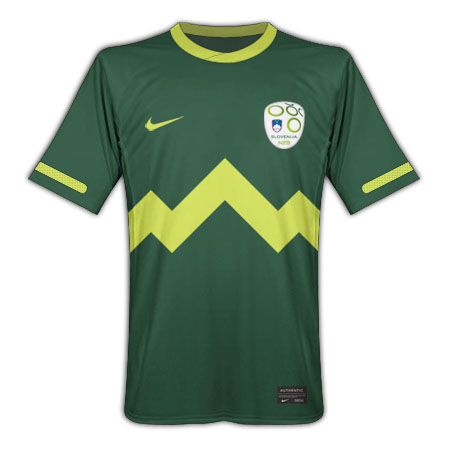
What geographical features could England have on their kit? The undulating path of the River Severn? The Lake District's craggy peaks? Or perhaps something a little less physical: a stone circle inspired pattern?
Mark asks who should be brought in as a football pundit to replace the droning Vuvuzelas of Thought and Comment that the current crop represent, and on the way drops in what should be etched on Shearer's gravestone: 'He looked like a squaddie who'd just beaten someone to death with a shoe.'
In many televised US sports they now have professional comedians as the co-commentator. I think this would be vastly preferable (in principle). We could end the say-what-you-see idiocy you get from the likes of Keown ('It's come out to him and he's hit.') or Le Saux ('He won't be happy with that' -- no shit Graham, he didn't score did he?) which suggests they believe themselves to be principally providing a service to blind viewers.
The problem with the ex-pro as pundit is they so rarely provide the actual insight their experience is supposed to furnish. You get the occasional figure like Strachan when he was on MotD2, who genuinely enlightens the audience... But mostly the performance as a pundit of a Platitude Production Engine like Shearer simply follows through on the logic of their appointment. That is, they've been appointed to these jobs simply through virtue of who they were and are. I'm sure that deep in Shearer's cerebral cortex lies an assumption something like: they gave me the job because of who I am - why should I need to do any homework? know who Marek Hamsik or Alexis Sanchez are? I don't need to work on being Alan Shearer. I don't need to train to be Alan Shearer. I AM ALAN SHEARER. HEAR ME PUNDIT.
Having co-commentators and post-match pundits drawn from outside the realm of the ex-pro would also introduce a cleansing sense of neutrality. Few things are more agonizing than watching Redknapp Jr jabber obsequiously about his Old Dad.
But the comic as commentator introduces a whole new raft of problems.
'And joining Simon Brotherton for England-Algeria, his co-commentator Michael McIntyre........'
Listening to yesterday's coverage on BBC Radio 5 live I caught a short discussion by Mark 'Chappers' Chapman and Martin someone or other. After an interview with Shaun Wright-Phillips, the discussion turned to how Capello is not telling players that they are part of the team until the very final moment. Martin said that this was causing uncertainty in the England camp and he detected this uncertainty and angst in Wright-Phillips' voice. "He sounds quite unloved, he's a long way from home, and you've got to start building the players together and you've got to love these players" Martin opined. Capello simply wasn't being fatherly enough to his players, and was being "hardline with the players" and "doesn't share that love around". Because of this insecurity, players cluster around Capello, trying to win his favour, grasping at any hint, "looking for any signs, any signal" that you've made the final teamsheet. This makes being on the England team "an insecure world". Without a lurch into a deep psycho-analytical discussion of this deep ontological uncertainty of being on the England squad, we should briefly note the ruthless infantilisation on display - Chapman's response was correctly akin to "he is a grown adult, not twelve year old boy". Yet this exchange provoked me to think of what the correct management style in fact is for international football. In contrast to Capello's supposed 'distant father' approach, the relationships between Diego Maradona and his Argentinian side was noted earlier in the day as being a hugely friendly one, embracing them warmly when they succeeded, but one where failure will be met with firm, angry, but ultimately loving words. Clearly, despite Capello's Italian origins, the commentators have mapped the management of England and Argentina onto cliches of national fatherhood - the seen and not heard type versus a perhaps violatile, but always loving Dad. Which led me to remember the classic article by Mark E. Smith on football management that surfaced during the last world cup. As readers will doubtless be aware, The Fall have a somewhat revolving door policy regarding personel, and seems to have adopting a similar stance to Capello:
Running the national football team is very much like running my group, the Fall. As a manager, you've got to maintain a certain detachment from your players, and it's the same with my musicians. When we're on tour, I sit at the back of the bus. We're friendly but the secret of it is never get too ally-pally. You can have a pint or two together now and again but you don't want to be going round their houses.
You don't want people to get too comfortable, because if they do, there's no way they'll be on top of their game. It's not a job for life. I see the Fall being like a football team with a two- or three-year cycle. There's always going to be a period where I'll need a new centre-forward.
I always like to keep a strong subs' bench of people who can step into the breach, cos you never know when you might need them in an emergency.
Well worth a read. Which leaves the question, how best is the affective work of managing a football team done? And more vitally, why have The Fall not previously been associated in World Cup football song, until 2010? We have Theme From Sparta FC.
I cannot let this pass without adding this video. Mark E. Smith reading the football results. The interview afterwards is sublime.
And the marvelous Kicker Conspiracy: "HOT DOGS AND SEAT FOR MR. HOGG! AAAAAANNNNDDD HIS GROTTYSPAWN!".
In the light of these, Smith's recent World Cup offering, and an outing for his 'soft voice' best witnessed in Bill Is Dead, seems a bit pale. Writing in the band Shuttleworth with Ed Blaney and Jenny Shuttleworth, the video is a sight to behold.
After watching, perhaps Mark is right to insist 'it's not a Fall song'.
Could I cope with England winning the World Cup? The boost it would give Cameron; the fact that John Terry and Steven Gerrard would be national heroes for evermore; the horrible jingoism that would break out. I'm not sure I'd handle all that too well. The sheer crapness of our nationalism rubs me up the wrong way. Car flags and Carling? I'll pass, thanks.
So I find myself in rather an odd position when England play. I take more interest in their games than most, and would currently register somewhere between 'really looking forward to' and 'excited' about tonight's game. It'll be nice to sit down with some friends and a beer and watch a match that we're all interested in. But it's always a bizarre experience, and my hostility to the national team fades into a vague, ironic ambivalence whenever they're actually on the pitch*.
This makes it an incredibly stress-free experience. I can still enjoy England winning, but a defeat or disappointing draw (particularly one punctuated by a characteristic English blooper or two) tends to be met with an wry amusement somewhere between fatalism and smugness. Maybe I'm a 'follower' rather than a 'supporter'- someone interested in the team, but who doesn't care about results.
There's a contradiction at the heart of this experience though. To keep enjoying England games, I need them to win some. Just when do I want them to lose? And there's the crux of the matter- I'm not sure I really do. Actually willing England to lose a game seems to slip over the line marking a lefty awkwardness with nationalism to a rather reactive, snobbish position- denying others their 'inferior' happiness so I can feel superior.
There's a further complication in that- as tournaments progress- I find subconscious support taking over my ironic stance. At least, this is what I've found in the Champions League- particularly in 2005. I've not liked Liverpool since suffering so many intolerably smug fans of theirs at secondary school, and I couldn't bare the thought of them feeling vindicated in their belief that Liverpool Football Club (it's always Liverpool Football Club, isn't it? As if they were somehow more of a football club than anyone else) are indeed The Greatest Team On The Planet. Yet when they staged that comeback, I found myself cheering them on- and I was genuinely delighted when Dudek saved Shevchenko's penalty. Would the same thing happen if David James, or Joe Hart**, or Michael Dawson, or whoever Capello's decided to trust in goal repeated the feat in the World Cup Final? I have a sneaky feeling it would, you know.
*All this will all be complicated further tonight by the fact that Algeria have Adlene Guedioura in their squad- a player I've come to like immensely during his short spell at Wolves so far. I was delighted when he was called up into their squad (despite being uncapped) and chuffed to see him come on in their opening match against Slovenia. The phrase "Good work from Wolverhampton Wanderers' Guedioura" is up there with my moments of the World Cup- though we had Seol Ki-Hyeon at the last World Cup it was fairly apparent he'd played his last game for us after a season in which he looked particularly uninterested, and it's still something of a novelty for me to have Wolves players in the World Cup (Hahnemann and Milijas complete our contingent this time round).
**I'd quite like Joe Hart to win the World Cup because then one of my claims to fame would be significantly more impressive. On my debut for Shifnal CC's second XI some 9 years ago, I strutted out to bat at London Road, Shrewsbury, and saw the home side bring on a lad of about 14. I was quite pleased by this turn of events, hoping it would mean some easy runs- but he proved to be rather rapid and had me caught in the gully- surprised by the bounce- with his third or fourth ball. I distinctly remember wandering back to the pavillion chuntering away, and exclaimed my surprise as to the lad's pace to a teamate. "Aye- he's a good little player. He's better at footy, mind- he's on Shrewsbury Town's books: plays in goal. They reckon he'll be in the first team soon."
... "France will make the quarter-finals." ... "We're always ready to start an autopsy without a body." With his counter-intuitive gambits on the BBC tonight, Danny Baker showed how punditry should be done. Baker was like a speedfreak thrown into a room full of somnambulists, gleefully providing all the controversy Tom English called in for in his blast against anodyne pundits in the Scotsman. It wasn't contrarianism for its own sake, but an intelligence that won't countenance mouthing platitudes even if they're true. Baker might be wrong, but his thought-bombs are always stimulating. Too often, the ITV and BBC panels manage to both state the obvious and be wrong. They extrapolate ploddingly on the basis of received wisdom and/ or what they've just seen, failing either to notice long-term patterns or to contemplate unexpected twists. Robbie Earle getting sacked by ITV is far more interesting than anything he's ever said. The only interesting thing about Alan Shearer is the faint air of suppressed violence that surrounds him: he looks like a squaddie who's just beaten someone to death with a shoe. Andy Townsend inarticulately and over-excitedly voices your own most banal thoughts, ten minutes after you'd dismissed them as too tedious to vocalise: he's like Trevor Brooking, but even more dull. Hansen retains a flinty charisma and a stern authority, but he's stale, lacking any foils.
The lesson: employ those with expertise in talking and thinking as pundits. Any other suggestions for who would make a good pundit?
It sounds as if Gary has already reached stage three of the grieving process described by Martin Samuel in the Mail today. Samuel applies the famous scheme devised by the German psychologist Elisabeth Kubler-Ross - and used by Zizek as the framing device for his latest book - to chart the England fans' gradual coming to terms with defeat:
First there is denial (if we win the tournament playing badly, nobody will complain), then anger (these players are hopeless, we're never going to win with this useless bunch), then bargaining (you know, I wouldn't even mind if we lost to Germany/Algeria/Papua New Guinea/the Platinum All Stars just as long as we play well and don't go out on penalties), depression (oh God, what's the point, I really can't take this any more) and finally acceptance (ah well, there's always next time, I bet Roy Hodgson could sort this lot out).
What's interesting about Samuel's application of Kubler-Ross is that the grief comes before the loss, which I think says a great deal about what the England team is up against. By this, I don't mean a hostile press - I think Samuels captures pretty accurately the state of mind of England supporters - I mean the mixture of wild hope and resignation that the England players must have to fight in themselves. When Jürgen Klinsmann was on the BBC last night reminiscing with Gary Lineker about Italia 90, he said that the West German team had a conviction that year that they would win the tournament. Lineker claimed that the England players felt the same, but it's hard to really believe that they expected to win. Expecting to win isn't the same as arrogance; and England over the last forty-six years have found it impossible to achieve that frame of mind where you expect to win, but make sufficient demands of yourself in order that you will achieve victory. England tend to struggle when they are the favourite to win, but freeze when they are the underdog, stirring themselves into their best moments only when the game is all but over.
Even given all this, it's hard not to think that the response to the US match here has been something of an overreaction - especially after the results of Spain, Italy and some of the other more fancied sides. Samuel's claim about 'momentum' is dubious: sometimes teams who win the World Cup start strongly; sometimes they stumble at first. (The one thing they don't do, at least not in any of the tournaments so far, is lose the first game: an ominous sign for Spain.) I suppose the overreaction might be because people had dared to hope that Capello might have ended this syndrome (England held or beaten by teams which they really ought to have defeated). But the USA game recalled the frustrations of campaigns past, raising the fear that not even Capello can overcome England's tournament curse.
Tomorrow's game? My sense is that England do best when they operate with a less rigid formation than they used against the US, with players moving more fluidly between midfield and attack. Last week, Rooney was like a negative version of this, marooned in some ineffective no-man's-land between midfield and the forward line. I also think that using two wingers tends to leave teams overrun in midfield, and with Wright-Phillips and Lennon playing on Saturday, Landon Donovan was able to dominate the middle of the pitch. (Wright-Phillips and Lennon were also a curious choice when you recall that Rooney doesn't typically score the kind of goals that they provide assists for. In addition, using two wingers also inhibits the forward running of our two full-backs, one reason, perhaps, why Ashley Cole in particular seemed so subdued agains the States. Then you have to bear in mind that with Wright-Phillips, Lennon and Heskey on the pitch, you had three attacking players who had minimal prospects of actually scoring a goal.) Barry's return should allow that greater fluidity in midfield. In defence, what's worrying is not Green - he's unlikely to make a mistake of that magnitude again - but the prospect of Carragher playing again. It was a real blow when England lost their best central defender (not the past-it Ferdinand, but King), but it's hard to believe that either Dawson (a very accomplished centre-half, who has done well for Tottenham this year) or Upson could do worse than the labouring Carragher, horribly exposed for pace many times on Saturday.
We've now seen 4 goals from Argentina and 3 from Uruguay in the last 24 hours. But before that there were many complaints about the low number of goals in this World Cup so far. What this reminds me of is that a large percentage of my fellow Americans still have no interest in the sport we call soccer, and that one of their main complaints is that the sport is boring. What I think they mean is that there isn't much scoring in a typical game.
Since many readers of this blog might not understand the rules of baseball or American football, I will be referring to basketball as a comparison. A typical score in an NBA playoff game might be something like 102-94. That's a lot of scoring. Even the losing team in a 105-72 blowout has succeeded in putting the ball in the basket many times during the night, and this is not true of the loser in a soccer match.
It is interesting to explore this theme of low scores in soccer (pardon me for using that word; "football" would be an affectation for me, since I never call it that in daily conversation). It is remarkable how many of the specific features of the sport of soccer follow from the pivotal fact that it is very difficult to score.
1. Patience is required when watching soccer. It's over 90 minutes of action, and you need to pay attention the whole time. During this World Cup alone, I have missed *three* interesting goals simply because I happened to be checking email messages on my iPhone: including, I'm ashamed to admit, the Clint Dempsey goal that went through Robert Green's hands. I saw that one on replay only. If you're watching basketball, and you're distracted by a phone call or a joke aimed at a friend, you might miss a beautiful play, but at least that beautiful play is unlikely to be the fulcrum of the entire game. But by missing Dempsey's goal in real time and seeing it only in replay form, I missed what could turn out to be the most interesting American moment in the Cup. Much patience and concentration is needed when watching soccer.
2. There is a much higher stress level when watching soccer than when watching basketball. Scoring opportunities are rare enough that one desperately wishes to capitalize on them. We were just reminded of this an hour or so ago, when South Korea blew a golden breakaway opportunity to tie the match 2-2 with Argentina. Instead, they crumbled after that botch and lost 4-1. If your basketball team blows a layup, they can still recover. But when South Korea blew that goal opportunity, I was pretty sure it might be their last of the day, and that turned out to be true.
3. A corollary of point 2 is that soccer seems filled with miracles generated ex nihilo. I'd rather trail by 12 or 15 points in basketball than by 1 goal in soccer. At least in the basketball case you can call timeout, change strategies and lineup a bit, and then measure your incremental progress over the next few minutes. "Oh good, we've cut the lead from 15 to 8 over the last 3 minutes. Momentum has shifted our way." In soccer, by contrast, goals come suddenly as gifts from the gods, and you can't tangibly measure your progress toward getting the next one. Just look at Switzerland in the 1-0 surprise over Spain, with commentators shaking their heads that the Swiss goal came "against the flow of play." In the NBA you could never say "that dunk came against the flow of play." A friend emailed me yesterday and wondered: "How on earth did North Korea score a goal against Brazil?" But obviously no one would ever ask of an NBA game: "How did a team as bad as New Jersey get a dunk against the Lakers?"
4. The deserving team doesn't always win. Yes, this also sometimes happens in basketball. You might find yourself once in awhile asking: "How did Miami win that game? It felt like Atlanta really outplayed them." Yet this can happen all the time in soccer, including in the World Cup. It is not that hard to dominate utterly in soccer and then lose 1-0 on a fluke goal, perhaps from a stupidly allowed penalty kick.
5. Subtle judgments of player performance are required. In a sport like professional basketball, there is a crude but useful tool for judging player performance: points scored. If someone scores 30 or 40 points in the NBA, that's a good game. It's true that points aren't the only thing, but many of the other features of a basketball game are also quantified by a sandstorm of statistical information. Even if Paul Pierce doesn't score a lot in Celtics-Lakers Game 7, if we read the following line we know he had a good game: 14 points, 11 rebounds, 8 assists, 5 steals, 3 blocks, 1 turnover. Despite the mediocre point total for Pierce, numbers come to the rescue and help us form a picture of what sort of game Pierce had. And in baseball statistics have taken over to a crushing degree, thanks to Bill James and sabermetrics. (For the benefit of non-American readers, "sabermetrics" was the brilliant James's whimsical coinage based on the acronym SABR, or "Society for American Baseball Research." Sabermetrics is a sophisticated set of statistical analyses applied to baseball, one that was a fringe intellectual pastime through the 1980's and 1990's but is now taken so seriously that some of the best teams employ sabermetricians in the office.)
By contrast, in soccer many aspects of a player's performance can't really be quantified, and judging them often takes on all the subtlety of wine-tasting. And so you get things like this (from the Sun in 2006), which would be completely unnecessary in basketball since numbers would do the work:
"Ashley Cole. Got through the 90 minutes in hot conditions but question marks still surround his fitness. Got forward without ever threatening and was given a good workout by Nelson Valdez."
"Frank Lampard. Tried his luck on numerous occasions but found Paraguay keeper Bobadilla equal to all of them, his low drive towards the end of the game the pick of the bunch. Forced backwards as Paraguay looked for an equaliser but stood strong."
In short, the simple fact of soccer being a low-scoring sport generates a number of other peripheral features, and it's hard to say which of these five features is most to blame for the United States only gradually warming to the sport.
However, we really are starting to warm to the sport. To give just one example, my American friend Casey in Egypt, a huge U.S. sports fan, recently abandoned all of our traditional sports in favor of a satellite dish and the English Premier League. He doesn't even stay up all night for the Super Bowl anymore. 10 years ago this would have been eccentric, but it's now cutting-edge hip in the U.S. to follow the English Premier League, if still not entirely widespread. Bill Simmons now frequently refers to English football in his NBA columns.
And finally, I was shocked on my recent trip home to enter a K-Mart (that's a low-end retail store) and find FC Barcelona duffel bags for sale: in Iowa! Absolutely unthinkable before a few years ago.
Amidst the muddle of some roundly criticized punditry on this World Cup (attacked most notably here), the tournament seems as if it's finally coming to life. We may now be more diverted by the quality of the football, rather than the at times insanely abstract drivel served up by those at the mic. Mark Lawrenson's reference to a "corridor of uncertainty" during the New Zealand v Slovakia tie the other day was a standout comment, alluding perhaps to some dark alternative version of the game accessed only by a trap door at the apex of 18-yard box and byline.
All this talk however does bring the contrasting opinions of those that have played the game professionally and those that haven't into sharper focus. Is there a discernable gulf in outlook between 'the game' and the punter, and a resultant difference in why we commit to following our respective nations?
The distance between player and fan wrought by commerce in recent years has of course been well-documented, in relation to the Premier League especially. But the player's objective of simply winning games versus a wish on the part of the fan to be entertained offers a particular contradiction, brought to light most starkly in this tournament's fairly tepid opening week. The classic contrast in styles that shaped the dynamic of the Brazil v North Korea and Spain v Switzerland games has offered tension, uncertainty and potential upset via the conflicting traits of skill and fluidity of movement versus aggression and organisation.
The specific predicament of England puts a new slant on the 'winning ugly' approach already discussed on this blog, and the failure to properly define a clear playing style arguably complicates expectations even further. Despite mining a largely typical northern European game based on physical strength, England have oddly reared, once or twice every generation, a player of naturally Latin technique. Unlike South American nations, who regularly boast half a dozen such ball players at any one time and can thus afford to drop one to the bench, England traditionally decide implausibly not to build a team around their sole playmaker (see Marsh, Hoddle, Waddle and now Joe Cole), and instead concentrate their resources on the kind of game lambasted by Franz Beckenbauer after the draw against the USA. Add to this the fact that in recent years, successive England coaches (two of which haven't even plied their trade on the 'kick and rush' English way at all) have predominantly rejected the passing game seen during the Venables and Hoddle years in favour of a more direct but somewhat aimless style of play, where possession is not the key ingredient.
So, in absence of both front to back flair and a basic possession game, England routinely look lost. Having endured so many disappointments at World Cups and European Championships over the years - usually under the delusion that we might just win it - I'm not quite so bothered about 'progress' per se this time. A chronic lack of depth in quality tells me that we honestly don't have much of a chance.
Why then should it be so strange to want simply to be entertained? Why not go all-out to score goals? Why not, instead of detailing wingers to nullify the progress of the opposition's attack, urge them to express themselves and create? As I write, Argentina, big favourites for many, have swept the South Koreans aside with some occasionally breathtaking forward play. They also have a terrible defence, but it doesn't look like Maradona or anyone else really cares about that. Brazil in '82 had a famously porous backline, but are renowned as being the greatest team never to win.
Even the most blindly optimistic appraisal suggests of course that the current England team are nowhere near that good, but whilst we are at least similarly dreadful at the back, it seems only to provide us with another great neurosis. And why shouldn't we want everything to be just right for this, the last chance for the 'golden generation'? In view of such determined turd-polishing (the performances at the last World Cup were, let's not forget, truly execrable, but hey - we made the last 8!), perhaps a somewhat more lateral attitude could be profitable. After all, what could be more destructive to the opposition than unrelenting attack, rather than a constant jockeying out of the (yet again) fear of conceding?
Is it just me or is this Youtube video of Maicon's fantastic finish not deliberately aged - as if the slight haze is meant to underline the goal's lineal descent from Alberto Carlos and Josimar?
Midway through the first half of the game between Switzerland and Spain, this happened.
When I was five or six years old sometimes with my mates we used to mark a goal - with sweaters or what have you - grab a ball and somebody would yell tutti contro tutti, 'everyone against everyone'. I remember this call to arms very well, but quite frankly I don’t recall what happened after that. A melee of some kind, presumably. How do you even play football without someone to pass the ball to? Were instant alliances formed and broken on the field, so that a subset of the mob could get closer to scoring a goal? Did we even have a goal to aim at, or is that part of the memory spurious? Perhaps we just dribbled aimlessly, enjoying the inevitable collisions. I couldn’t say. I doubt that as a practice it lasted very long, we must have quickly switched to selecting the two fellows who would take turns picking players so we could get started with a proper game in short order. This I remember very well. It was done quickly because, especially during the morning break at primary school, each moment was precious, and every second that wasn’t spent playing football, wasted. And we kept score, unfailingly, I’m sure of that, although, since the make-up of the teams changed from day to day, it was only the personal stats that carried over.
I remember the first time we played against a team wearing a proper football kit. We must have been eight or nine years old, and they were kids from the area (but not from our school, I think) sponsored by the local pizzeria. They beat us nine to one. I’ll always maintain that they beat us because they had proper shirts. We were just intimidated by that. Some time later they agreed to play us again and this time we won by a goal. We had had a talk in advance about tactics and what we should do, and we remarked that their superior equipment wasn’t a reflection on their skills, or ours.
What is it that is so powerful about shirts, about the team’s colours? I used to think that it was a primal affair, hardwired into us boys especially - my memories of kindergarten all revolve around belonging to a gang, and each gang had its own colour, matching the colours of the rooms at the school. (We didn’t actually wear those colours or anything like that, it was more of a symbolic thing.) But what about tutti contro tutti, then? Where does that fit in, where did it come from?
Gangs of adults form around professional football teams at all levels, each swearing to defend those blessed colours. Footballers become simulacra, heroic figures for as long as they wear the correctly coloured shirt. When national teams are involved, they even make you swear allegiance before each game, when you line up for the anthems. And us supporters at home or at the stadium quietly do the same - each siding with the team from our own country because it is the obvious, the natural, the non-dickish thing to do.
What intrigues me about the image at the top of this post is that it that it makes it look as if Philippe Senderos had somehow forgotten in a moment of folly that most fundamental rule of the game - it is us versus them, the white shirts versus the red shirts - and had tackled his team-mate on purpose, like in one of those Hobbesian childhood games of ours, where all that mattered was to gain temporary possession of the ball. Of course, it’s not really what happened, the full replay shows that the two defenders were both going for the same ball, and Senderos was quite oblivious of Lichststeiner’s run. Nothing to do with Senderos being half-Spanish, either, which was one of the insipid storylines on the eve of the game. It was just an accident.
You couldn’t even imagine what everyone against everyone would look like, with adult footballers, in a visual cacophony of differently coloured shirts, could you? Except I suspect it would make a good commercial.
The Spain-Switzerland result today underlined a number of the things I've been trying to say: the 'best' teams don't always win; keeping possession of the ball isn't necessary to succeed . As Mick McCarthy grudgingly conceded in the BBC commentary, "there's more than one way to win." Possession: Spain 63%, Switzerland 37%. This wasn't a matter of blind chance or good luck. The truth is, Switzerland had a game plan to snuff out Spain's strengths, which they executed flawlessly. Spain had no answer to the superbly organised display that the Swiss defence put on today, reminiscent of Italy at their miserly best. Villa looked ineffective; only when Torres came on did the Spanish team briefly muster a sustained threat. But as the game wore on, it looked unlikely that Spain would find the key - indeed, by the final minutes, it almost seemed that Switzerland had an extra player, so successfully were they intercepting and blocking Spain's attacks.
I've watched plenty, and debated plenty, and filled in my wallchart diligently (sans error, thus far). But it feels like nothing's going in. "Of course it's not", said a friend, "there's been nothing to go in".
That's not quite what I was getting at, though. What I worry about is not so much that the football's not going but that the feeling of this World Cup isn't going in. I'm not getting a sense of the aesthetic universe that goes with the football (as I type, Jurgen Klinsmann has- in his strange Teuto-Californian drawl- just spoken of something similar, saying that there's something about a World Cup that "goes beyond a 4-4-2 or a 4-5-1 or whatever").
It's probably because of my age. USA'94 is the first World Cup I spent any time watching and that and the '98 tournament that are lodged in my mind as some of the strongest memories from childhood. I remember far more about the football from 2002 and 2006, but they don't seem so special- there's no magic to the memories.
I was 9 during USA '94. I remember precious little of the football. I think I remember Aldridge going mad at a FIFA Official but it could well be a false memory brought on by seeing it so many times since. And I'm fairly certain I remember Maradona's celebration against Greece- though I couldn't tell you if I was watching live or saw it on a highlights show. I vaguely recall someone being sent off, but I couldn't tell you who it was or what it was for.
I do, however, remember the strange quality of the light that illuminated so many of the games- an intense, anemic glow that saturated everything; sucking in colour and making it all look decidedly unreal. The 16 years since might have exaggerated this memory- and watching footage of it on YouTube does little do deny or affirm it- but it's certainly how I remember experiencing it.
What really sticks in my mind, though, is the Bulgaria v Germany quarter-final. I watched it because my friends at school were telling me how it would be great if Bulgaria won, and when we played football in the playground at lunch my class got to be Bulgaria whilst 4M2 had to be Germany. Without having any idea why (just as I'd had no idea why my peers were all shouting for Denmark in the Euro '92 final two years previously), I was desperate for Bulgaria to win.
And so they did. I remember being pleased Bulgaria won but am fairly certain I only know Letchkov's header for watching it since. Rather, what I remember from the match itself is that suddenly the colour had returned (thinking about it now, this probably has something to do with the match being played in New York's more moderate climate) and the wonderful patterns on the playing surface. It was incredible, and I remember thinking how much fun it would be to play on a pitch that looked like that.
I wasn't allowed to watch the final: it went on too late, so it was videoed and I got up early the next morning to watch it, something I frequently had to do with night-time TV (why getting up early and losing sleep was worse than going to bed late and losing sleep I didn't understand then and don't now, an act of parenting that I always thought would explain itself when I grew up but which still seems petty, although it does mean I have a good selection of games on VCR: the '94 European Cup Final, the '95 Cup Winners' Cup Final)- but I found the game rather dull so fast-forwarded through most of it. After a while I became so bored I asked dad what the final score was, and when he said it had been 0-0 and won on a penalty shoot out I didn't bother with the rest. France '98 wouldn't be dull though. England were going to win it! Euro '96 had got me into the national team, and I had carefully tippexed and red biroed a St.George's cross on my calculator in anticipation of our impending victory (something, I'm semi-pleased to note, kids still do now). John Summers brought his mum's pager into school and passed a note around English class saying that we were beating Tunisia 1-0, and then told the bus home that Scholes had added a second. We were definitely going to win. Something Kevin Keegan thought against Romania, only for Dan Petrescu to break clear and make him look a bit daft. Hoddle defied critics by playing Anderton and Beckham against Columbia and they both scored. How clever we all thought he was, although no-one wanted to be Darren Anderton on the school field the next day.
And then we were out.
My clearest memory of that game is fighting off the tears during ITV's slow motion montage following our exit (set to Green Day's Time of Your Life), and climbing folornly into bed in my England pyjamas, muttering that I didn't want to go on the next day's school trip to Alton Towers.
What also sticks in my mind from that tournament is the opening titles- perhaps because I could play the Jean Michel Jarre and Faure pieces used by ITV and the BBC, and so experienced a sudden surge in popularity during music lessons. If I hear either piece of music now, I'm temporarily transported into a state of heightened emotion: all boyish excitement and nerves- an intensity of feeling that always escapes voluntarily recalled memories. In writing this piece I watched those titles t for the first time in the 12 years since. Objectively, they're both a little naff now (though the ITV one in particular has some nice touches), but they still moved me as I recalled all the excitement they once roused.
No World Cup since has anything to match. I remember far more about the football in 2002: having a free period at college and being able to watch France lose the opening game; Beckham's redemptive penalty; Rivaldo's dive; Seaman's cock-up...but not a lot else sticks in the mind. I just watched the titles to the BBC and ITV coverage of 2002 on YouTube, but neither raised a glimmer of recognition, let alone evoked an emotional response (unless a brief Orientalist critique of ITV's counts). 2006 was fun- I was at uni, could legally drink and watched every game in the company of great friends- but the wonder had gone. In neither tournament did I care about England; in neither tournament did I learn about new countries, or new players- I knew too much and there was nothing to discover.
Perhaps rather naively, I longed for that boyhood feeling to return with this World Cup. I'm enjoying it greatly, and am looking forward to watching some games with supporters of other teams (doing a PhD means I have colleagues from Chile, the USA, Mexico...); as well as being abroad for the semi-final and finals (in Poland, so it's a shame they've not qualified)- but the idea that by watching all the games diligently I'd recapture the excitement of my youth has proved too much. It's rather blending in with 2002 and 2006.
Yet it could be that the thing I remember the most from this World Cup isn't registering consciously. I didn't decide to take in the titles in 1998; they lodged themselves in my mind involuntarily. Maybe something's worming its way into my brain right now, and one day it'll open a door for me to look back upon these next few weeks as a period of World Cup utopia.
Or: why you won't win the World Cup without seven Northerners
The London Review of Books is blogging the World Cup, with mixed results. This post, by R. W. Johnson, apart from being anti-vuvuzela (bzzzz) is riddled with odd ideas. England's '66 team 'had a core of Northern grit' - Alan Ball, Ian Callaghan, Roger Hunt, 'plus Jack and Bobby Charlton, Nobby Stiles and Ray Wilson.'
Those seven played in almost every game. This year’s team is very different. True, it has three vital Scousers – Rooney, Gerrard and Carragher – but the bulk of the squad comes from the South, reflecting the perhaps inevitable rise of London clubs in the age of giant cheque books. It is not exactly confidence-inspiring that England rely on Heskey and Crouch, both explicitly rejected by Liverpool.
Apart from the absurd stereotyping involved in the notion that a squad should be largely born north of Birmingham, Liverpool wanted to keep Crouch and only let him go reluctantly, while Heskey was almost brought back to the club, before he opted to move to Villa instead.
Even more peculiar is the notion that, if London clubs had a financial monopoly, they would buy players locally from the home counties. The logic of unregulated trade, money without borders, means that the big clubs buy the very best, whether they are from Ivory Coast, Czech Republic, Ukraine, or Brazil. As for the London clubs' 'inevitable rise in the age of the giant cheque book'... The richest club before Abramovich bought Chelsea was Manchester United. And even now, the richest club is Manchester City. Northern clubs have never been slow to spend: from Newcastle and Leeds' (catastrophic) sprees, all the way back to Sunderland's 1950s nickname: the 'Bank of England' club.
Still, this Diary piece by Johnson for the LRB in the run-up to the tournament is excellent.